

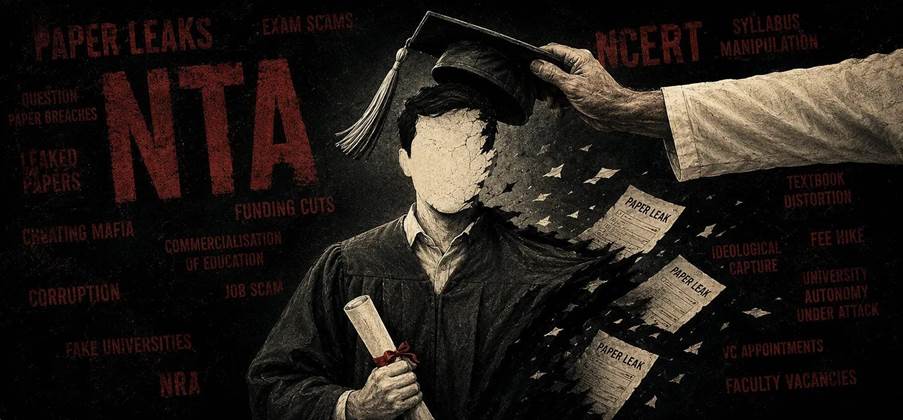
Fasting social activist Sonam Wangchuk and the Coackroch Janata Party (CJP) have massively shifted the goalposts of their demands, from demanding the resignation of the Union Education Minister Dharmendra Pradhan to now having a diluted laundry list of “this or that”, effectively putting the onus on the Opposition parties. Many youngsters genuinely believed that this movement could usher in change. But youngsters are idealists. They don’t know that protests in India, in the current context, are orchestrated mechanisms to release some steam of anger and anti-incumbency against the government, effectively acting as a ‘safety valve’. I have been saying this since day one.
First things first. Something about this series.
The Parliament Papers is a forward-looking initiative to find solutions, seek accountability and raise difficult questions. It is my way of gathering notes from the House. It will bridge the gap between Politics (political economy) and Policy (hardcore solutions).
Thanks for reading India Centre Media! Subscribe for free to receive new posts and support my work.
Day 1 of the Parliament: What it must take up
Every Parliament has defining moments. Some are remembered for the laws they pass. Others are for the debates it refuses to have. The Monsoon Session opens with one such moment. The country’s education system is on the brink of complete collapse. There are several aspects to it. Both politically and policy-wise. I am highlighting three important aspects that should concern the young.
First, the Joint Committee examining the Viksit Bharat Shiksha Adhishthan (VBSA) Bill, 2025 was expected to finalise its report before Parliament convened. Instead, its meeting was cancelled and the report deferred. That delay should not be treated as a procedural inconvenience. It should be seen as an opportunity.
The VBSA Bill seeks to fundamentally redesign who controls Indian higher education, how universities function, who regulates them, and ultimately, who decides what academic freedom means.
The proposed legislation abolishes the UGC, AICTE and NCTE and replaces them with a single apex regulator. On paper, this is presented as administrative efficiency. In practice, critics fear it concentrates unprecedented authority within a single centralised structure. Even the Joint Parliamentary Committee expressed concern that excessive centralisation could undermine institutional autonomy.
Education is a Concurrent List subject under our Constitution. Yet the proposed architecture vests overwhelming control in the Union Government while diminishing the role of the States. Appointments become increasingly centralised. Universities challenging regulatory decisions could find themselves appealing back to the very executive that controls the regulator. Critics have also questioned whether the new structure adequately safeguards institutional diversity and representation.
Universities flourish because governments create space for scholarship. They corrode when governments supervise scholarship, and autonomy is lost. The Bill also creates a curious contradiction. It separates regulation from funding. The regulator will prescribe standards but will not finance them. Universities will be expected to build world-class laboratories, recruit faculty, and improve infrastructure, even as funding increasingly comes from elsewhere. Critics warn that this risks pushing public institutions toward higher fees and greater dependence on self-financing models. This shift did not begin with this Bill.
Years ago, the Higher Education Financing Agency (HEFA), jointly promoted by the Ministry of Education and Canara Bank, marked a significant change in how higher education infrastructure was financed. It sought to make the UGC toothless. Instead of relying primarily on grants, institutions increasingly accessed loan-based financing for capital expenditure. It weakens the traditional grant-based model that allowed public universities to expand without transferring costs to students. This effectively means that the students will have to bear the burden of increased fees.
This is why the present debate cannot be reduced to one piece of legislation.
Which brings me to the second aspect of this overhaul.
Over the past decade, university leadership appointments have repeatedly become politically contentious. It is not a secret that RSS calls the shots in the appointments of Vice Chancellors. Political entities across the world use their loyalists and cadres to take over the ‘system’. There is nothing fundamentally wrong with it, but when mediocrity replaces merit, then the alarm bells should ring. Faculty vacancies continue to remain high across many universities. Public expenditure on education remains well below the National Education Policy’s stated aspiration of 6% of GDP. UDISE+ data records large-scale school mergers and closures over the past decade. National assessments continue to show worrying gaps in foundational learning. Graduate employability remains a major challenge outside a handful of elite institutions.
The debate becomes even more urgent because it coincides with another crisis—the credibility of India’s examination system, which brings me to the giant elephant in the room. The third aspect of Paper Leaks.
Paper leaks are no longer exceptional events. They have become recurring headlines. According to an estimate, since 2014, an astounding 152 Paper Leaks have taken place.
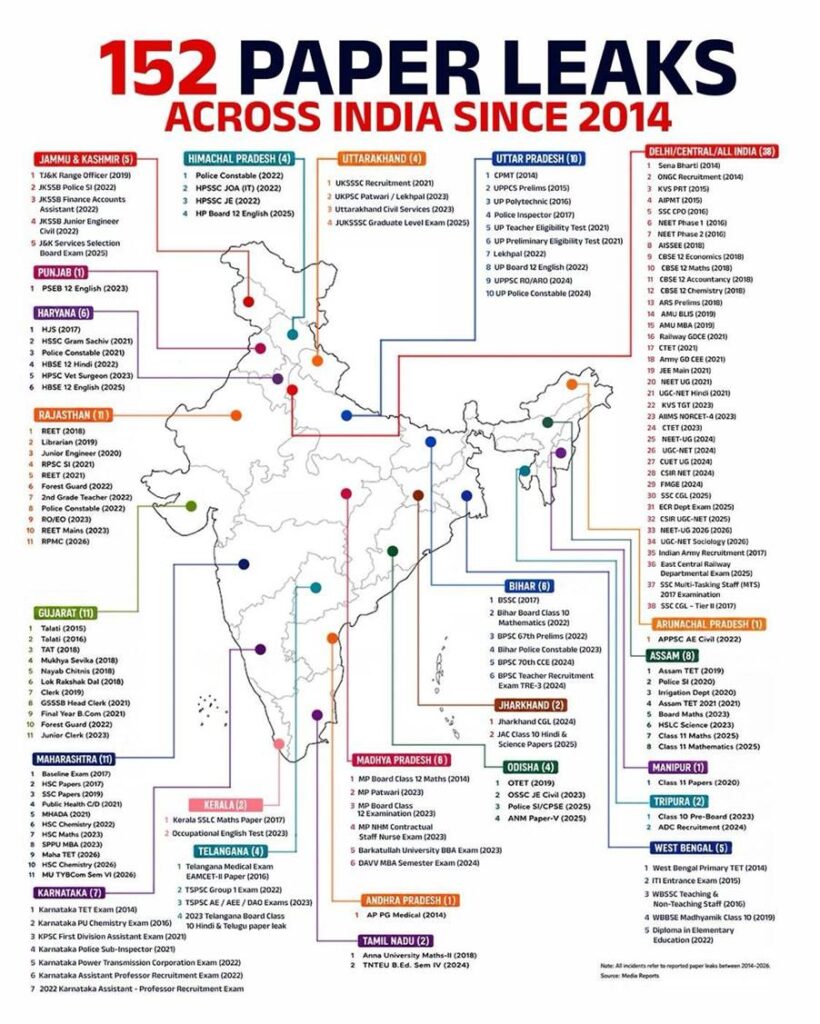
Students preparing for competitive examinations invest years of their lives. Families mortgage land, exhaust savings, borrow from relatives and banks, hoping education will provide dignity and opportunity. When examinations are compromised, the loss is not merely academic. It is economic, emotional and deeply personal.
The recent mobilisation under Chhatron Ki Goonj, led by Rahul Gandhi, has sought to channel this frustration into demands for accountability and structural reforms. At the same time, social activist Sonam Wangchuk’s prolonged hunger strike has focused renewed national attention on the examination crisis and institutional accountability.
Different political platforms may choose different methods.
But the underlying question remains the same.
Can young Indians continue to trust the institutions responsible for their future?
That question inevitably brings attention to the National Testing Agency.
The NTA Connundrum
The National Testing Agency (NTA) was created to make examinations more transparent, efficient and credible. Instead, repeated controversies surrounding major entrance examinations, including NEET. These have raised serious concerns about governance, security and public confidence. Paper Leak Mafia rules the roost. The young are questioning.
Another underplayed, lesser-known institution is the National Recruitment Agency (NRA), which was announced with the promise of a Common Eligibility Test that would simplify recruitment for millions of aspirants. Years later, no implementation has taken place, while candidates continue to navigate multiple examinations, cancellations and uncertainty. Independent reporting has documented how millions of applicants continue waiting for reforms that were promised but remain incomplete.
Primary education, too, has not remained immune to the corrosion. The NCERT syllabus rationalisation exercise removed or reduced several historical and political topics. The latest controversy surrounding the Bronze statuette of a dancing girl from the Indus Valley Civilisation is only one example of how the rot of mediocrity has reached our textbooks. Mughals, Nehru, Gandhi, Netaji Subhas Chandra Bose – all have been systematically removed or reduced from NCERT textbooks. Political colouring of textbooks has become more ingrained and solidified in the last twelve years.
Equally important is the shrinking space for dissent within universities.
Student politics has historically been a nursery for Democratic leadership. Many of India’s foremost political leaders began their public lives on university campuses. Yet in recent years, several campuses have witnessed increased police intervention, criminal proceedings, and heightened security responses to student protests.
A Democracy should not fear its students. Universities are meant to produce questioning minds, not silent classrooms.
This is why reducing the Parliamentary debate to the resignation of one minister would be inadequate.
Individual accountability matters. Ministerial responsibility matters. But Parliament owes the country something larger.
It must ask whether India is witnessing not a series of disconnected failures, but a gradual restructuring of its education system- through changes in regulation, funding, governance, curriculum, recruitment and institutional autonomy.
Members of Parliament should use this session not merely to argue over one Bill.
They should ask a far bigger question.
What kind of education system does India want to build for the next generation?
Because once institutions lose their autonomy, restoring them takes decades.
When education loses public trust, the price is paid not by governments, but by an entire generation.