

PM’s announcement of Fast Track Courts to deal with paper leak cases is an inadequate, response, smacks of tokenism.
In a midnight close-up video, where he replaced his classic “Mitronnnn” to “Friendzzzz” ( perhaps, to address the justifibly enraged Gen Z! ), PM Modi spoke about getting a Bill in the Parliament to establish Fast Track Courts (FTCs) in the Parliament in the next few days. The Bill may receive Cabinet clearance today. Sonam Wangchuk ended his fast, minutes after this announcement. He also asked protesting students to go around the country and submit a report to the PM (sic).
We already have a law against Paper Leak – The Public Examinations (Prevention Of Unfair Means) Act, 2024. So why do we need another one?
Also, Modi Govt’s CBI has already given a CLEAN CHIT to NEET-2024 Paper Leak mastermind, Sanjeev Mukhiya, saying there is no evidence for paper’s theft or distribution
Without meandering much, today, i shall only focus on whether the system of Fast Track Courts have actually worked in the country.
Fast Track Courts and the Illusion of Speed
India has been experimenting with Fast Track Courts for over two decades. The Government itself has acknowledged the central contradiction. In a reply before Parliament, the Ministry of Law and Justice admitted that no time frame has been prescribed for disposal of different categories of cases by courts. If a Fast Track Court has no legally enforceable timeline, in what sense is it fast? The very foundation of the model stands weakened.
Fast Track Courts were conceived as dedicated courts for categories of cases requiring urgent attention. The Eleventh Finance Commission recommended 1,734 such courts in 2000. The Fourteenth Finance Commission later recommended another 1,800 courts between 2015 and 2020 for heinous crimes and cases involving women, children, senior citizens and other vulnerable groups. Despite repeated announcements, India has never built the judicial capacity necessary to make these courts consistently fast.
As of 31 January 2026, 862 regular Fast Track Courts were functioning across only 21 States and Union Territories. The distribution was strikingly uneven. Uttar Pradesh had 373, Maharashtra had 105 and West Bengal had 88, while several States and Union Territories had only a handful or none at all. The Government has also stated that no central assistance is currently provided to States for establishing these regular Fast Track Courts.
More significantly, the Centre admitted that it had conducted no recent independent third party evaluation of their functioning and had no proposal to expand them through a centrally sponsored scheme.
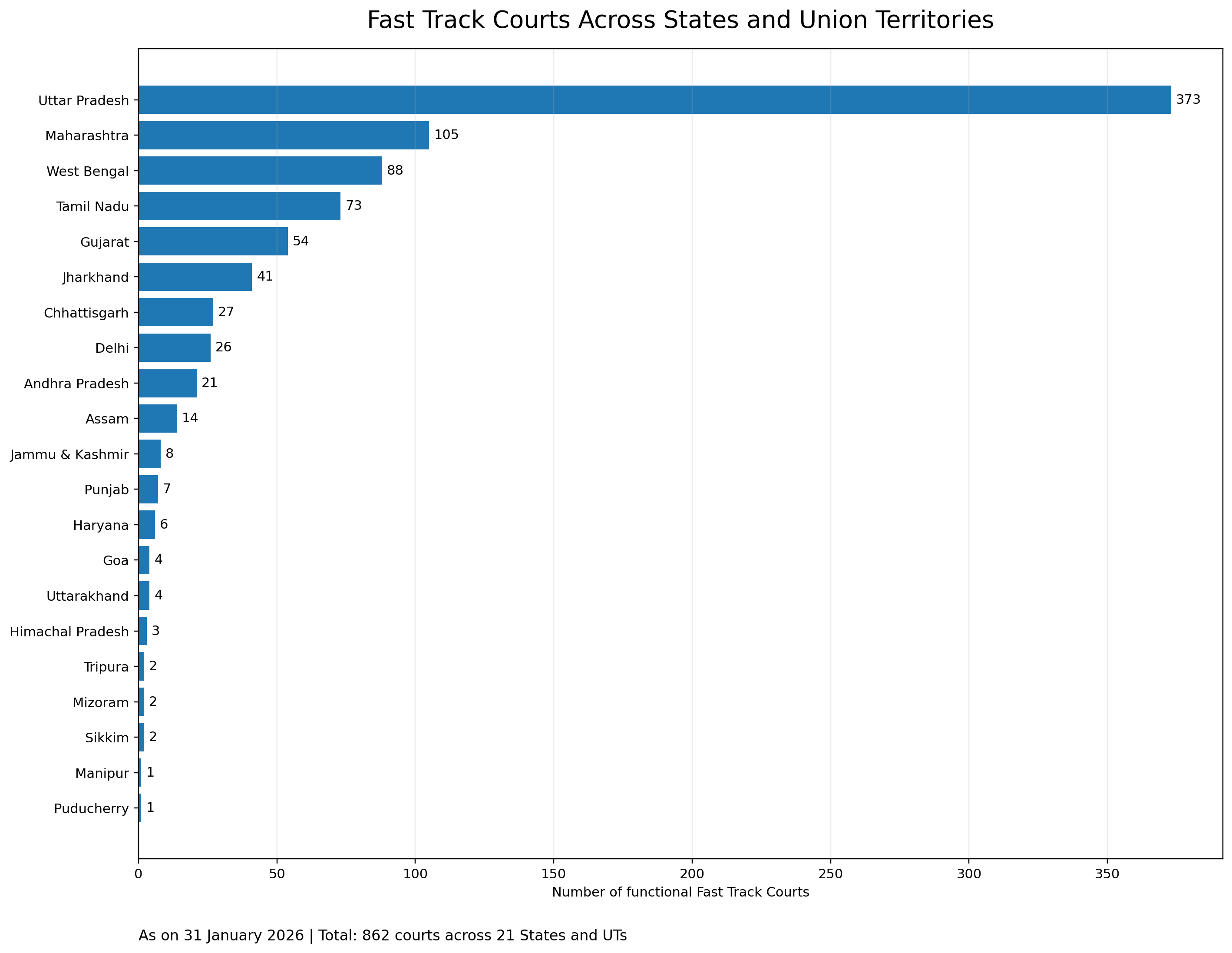
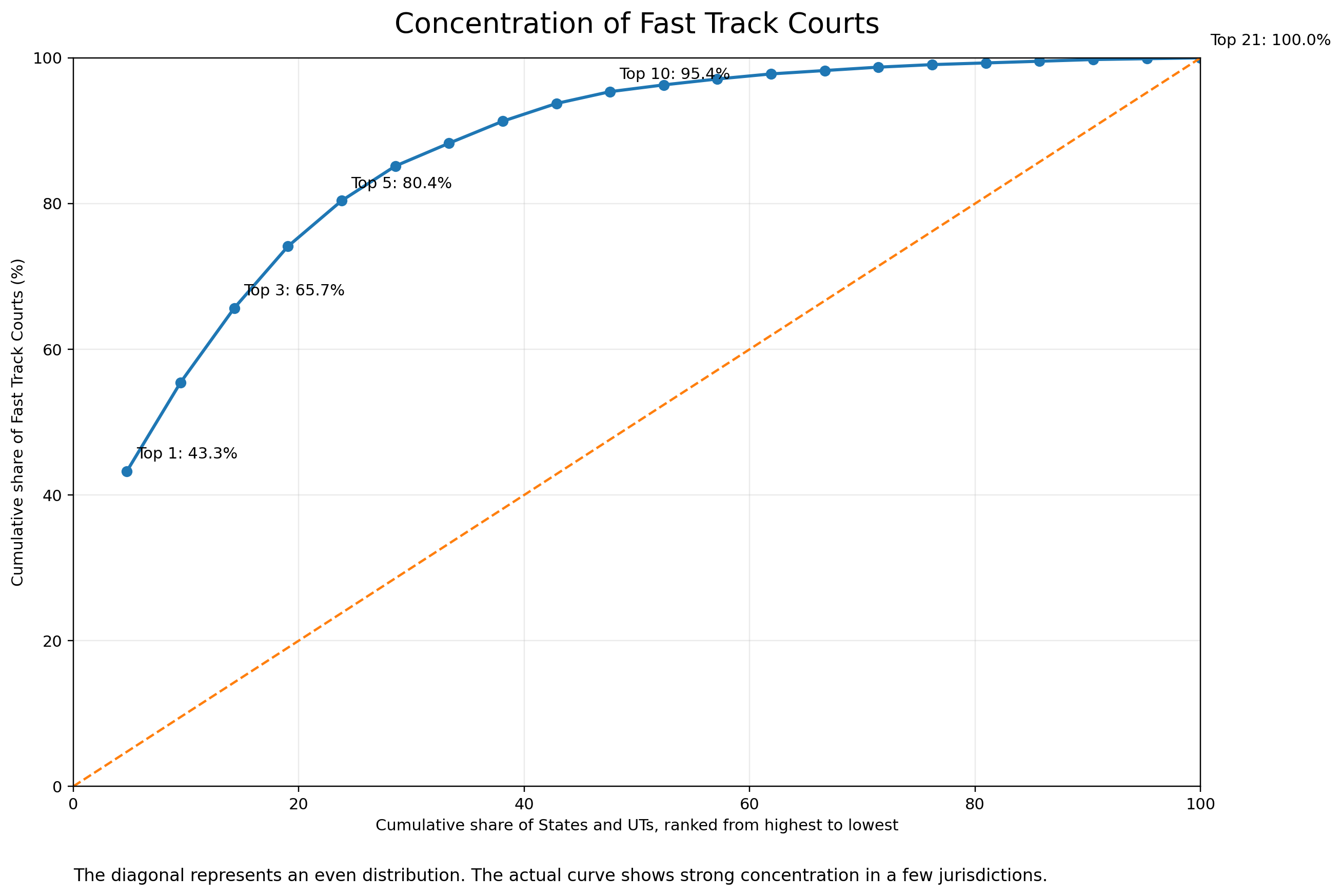
862 Fast Track Courts exist across only 21 States and UTs. Nearly half are concentrated in just three States, while several States and Union Territories have fewer than five courts.
The position of Fast Track Special Courts is only marginally more reassuring. These courts were launched in October 2019 for rape and POCSO cases. As of January 2026, 774 were functional, including 398 exclusive POCSO courts, against the scheme’s target of 790. The programme has already been extended twice, most recently until 31 March 2026. The repeated extensions themselves reveal that the original objective of quickly clearing pending cases has not been achieved.
Fast in name, ordinary in functioning
The fundamental weakness is built into the design. Fast Track Courts generally follow the same laws, evidentiary requirements and trial procedures as ordinary courts. They depend upon the same police officers, forensic laboratories, prosecutors, witnesses and administrative machinery. A separate courtroom does not create a separate justice system.
The Union Government has itself acknowledged the causes of delay. These include inadequate physical infrastructure, complexity of facts, poor quality of investigation, the nature of evidence, insufficient forensic support, witness related difficulties, legal representation and procedural requirements.
The source document provided for this article identifies the same institutional failures: judicial vacancies, inadequate infrastructure, delayed investigations, shortage of forensic support, frequent adjournments, repeated transfers of judges and the absence of specialised training. These conditions affect ordinary courts and Fast Track Courts alike. Changing the name on the courtroom door cannot remove them.
Most damagingly, the Government has acknowledged that no fixed time frame has been prescribed for courts to dispose of different categories of cases. Cases in Fast Track Special Courts may ideally be expected to conclude within a year, but that expectation is neither a statutory guarantee nor an enforceable deadline. A victim cannot demand a judgment within that period merely because the case has been assigned to a Fast Track Court.
A court without a prescribed time frame, dedicated manpower or measurable accountability is being asked to deliver speed through nomenclature alone.
BJP -ruled Delhi shows how the promise breaks down
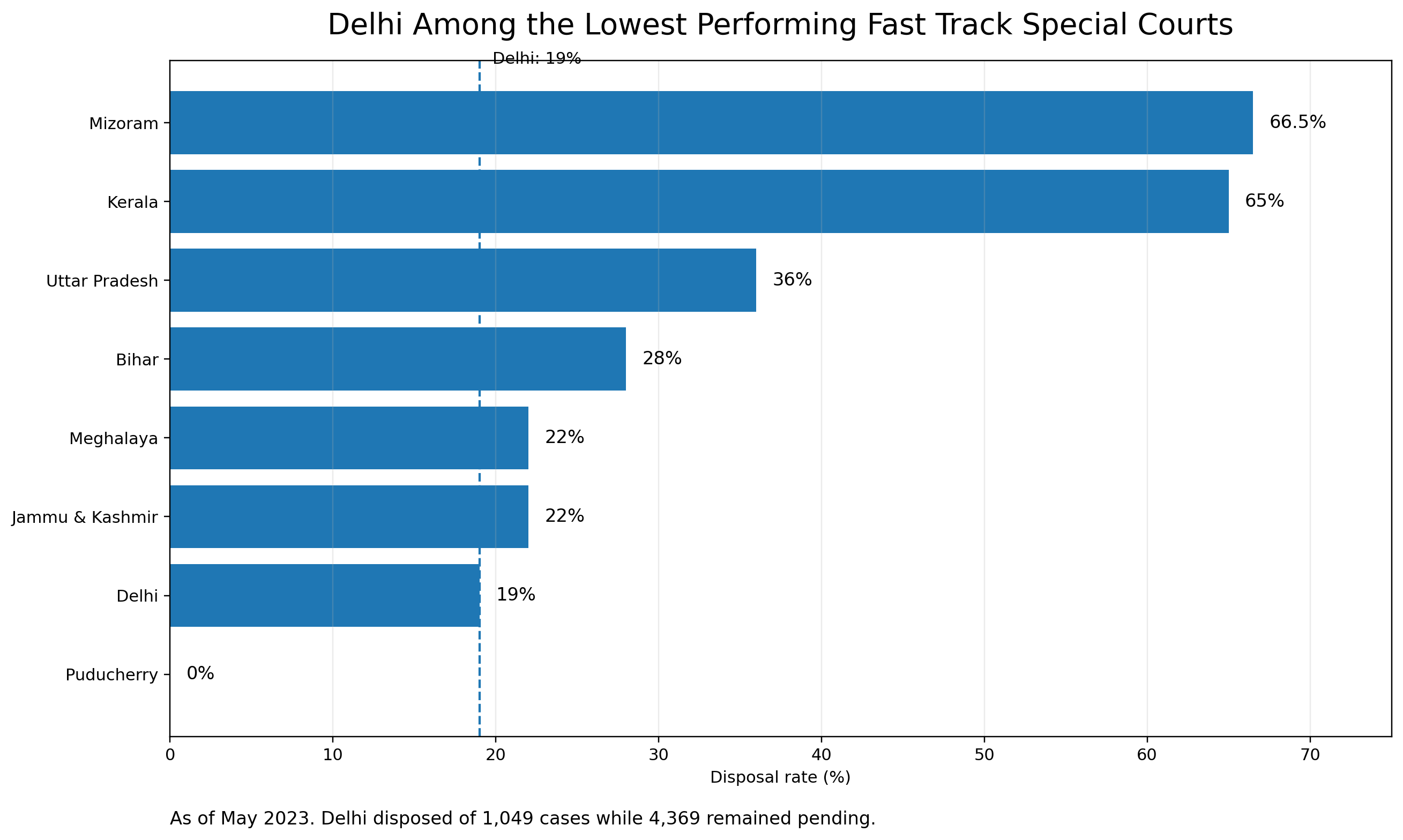
Delhi provides one of the clearest illustrations of this gap between announcement and performance. And we know that Delhi’s law and order is directly controlled by the Union Home Minister. According to an analysis by The Indian Express, Delhi’s 16 Fast Track Special Courts had a disposal rate of only 19 per cent as of May 2023, among the lowest in the country. They had cumulatively disposed of 1,049 cases while 4,369 remained pending. By comparison, Uttar Pradesh recorded a disposal rate of 36 per cent, Bihar 28 per cent, Mizoram 66.5 per cent and Kerala 65 per cent. (The Indian Express)
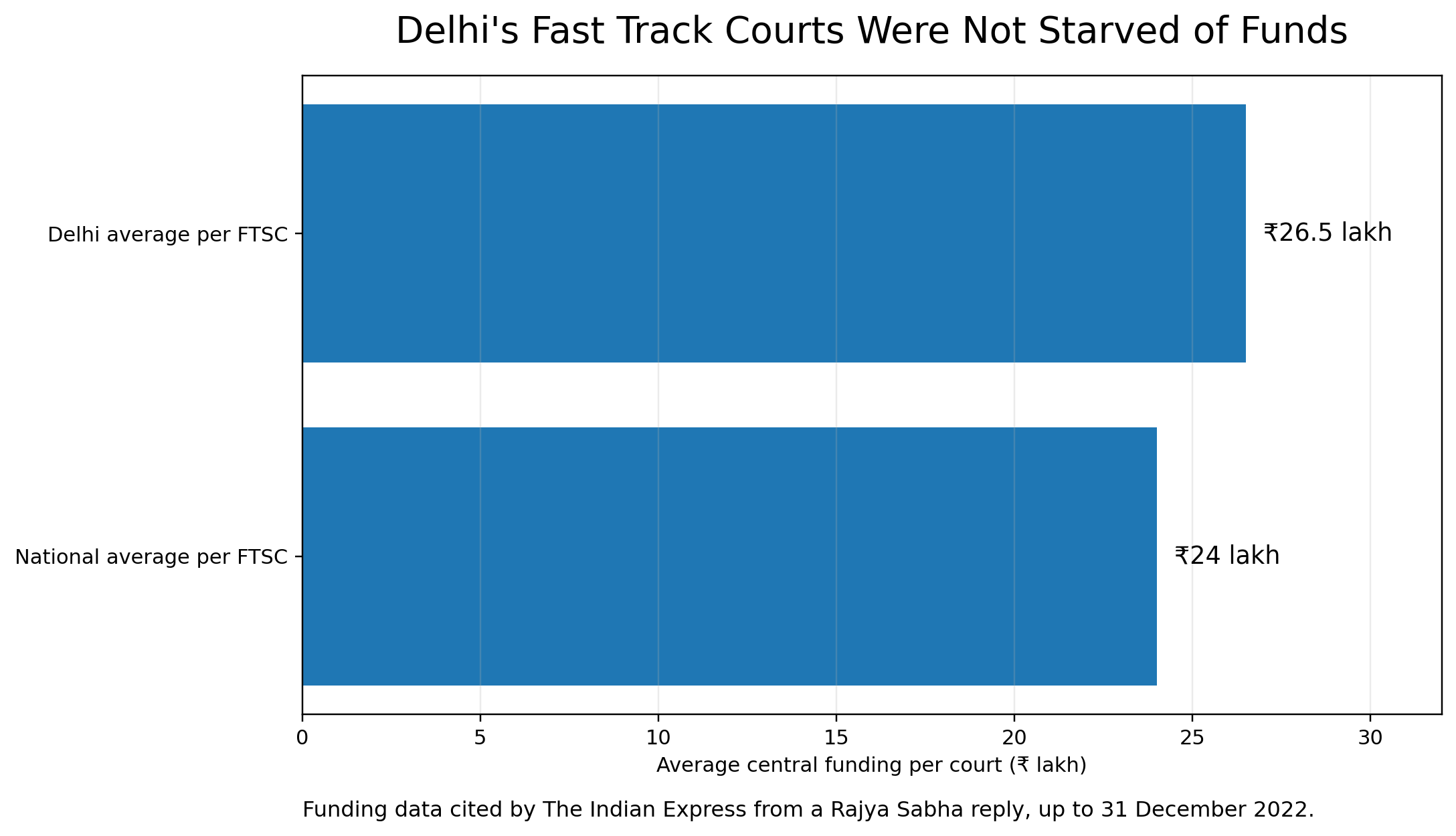
The contrast cannot be explained merely by the number of courts. Delhi had approximately one special court for every 12.5 lakh people. Uttar Pradesh had one for every 10 lakh people. Nor can the problem be reduced entirely to funding. Government data cited in the report showed that each special court nationally received an average of about ₹24 lakh, while a Delhi court received approximately ₹26.5 lakh. (The Indian Express)
The deeper problem was capacity. In 2022, subordinate courts across India had 5,850 vacancies against a sanctioned strength of 25,042 judges, a vacancy rate of approximately 23 per cent. Delhi’s subordinate judiciary had a vacancy rate of 22.9 per cent. Yet its disposal rate remained less than half the national average cited in the analysis. (The Indian Express)
Individual judges were carrying workloads that made the promise of speedy justice almost impossible. A POCSO judge in Delhi reportedly handled at least 250 to 300 cases, with the burden reaching as high as 750 cases in some courts. One judge described waiting for as long as eight years for a forensic report and having to repeatedly pursue investigating officers for supplementary chargesheets. (The Indian Express)
These are not minor administrative inconveniences. They determine whether evidence survives, whether witnesses remain available, whether victims retain the emotional strength to continue and whether a trial reaches a credible conclusion.
The national evidence is equally troubling
Historical data also challenges the assumption that placing a case in a Fast Track Court automatically shortens the trial. An analysis based on National Crime Records Bureau data for 2018 found that 78 per cent of approximately 28,000 trials completed by Fast Track Courts took more than one year. Around 42 per cent continued for more than three years, while 17 per cent took over five years. (The Leaflet)
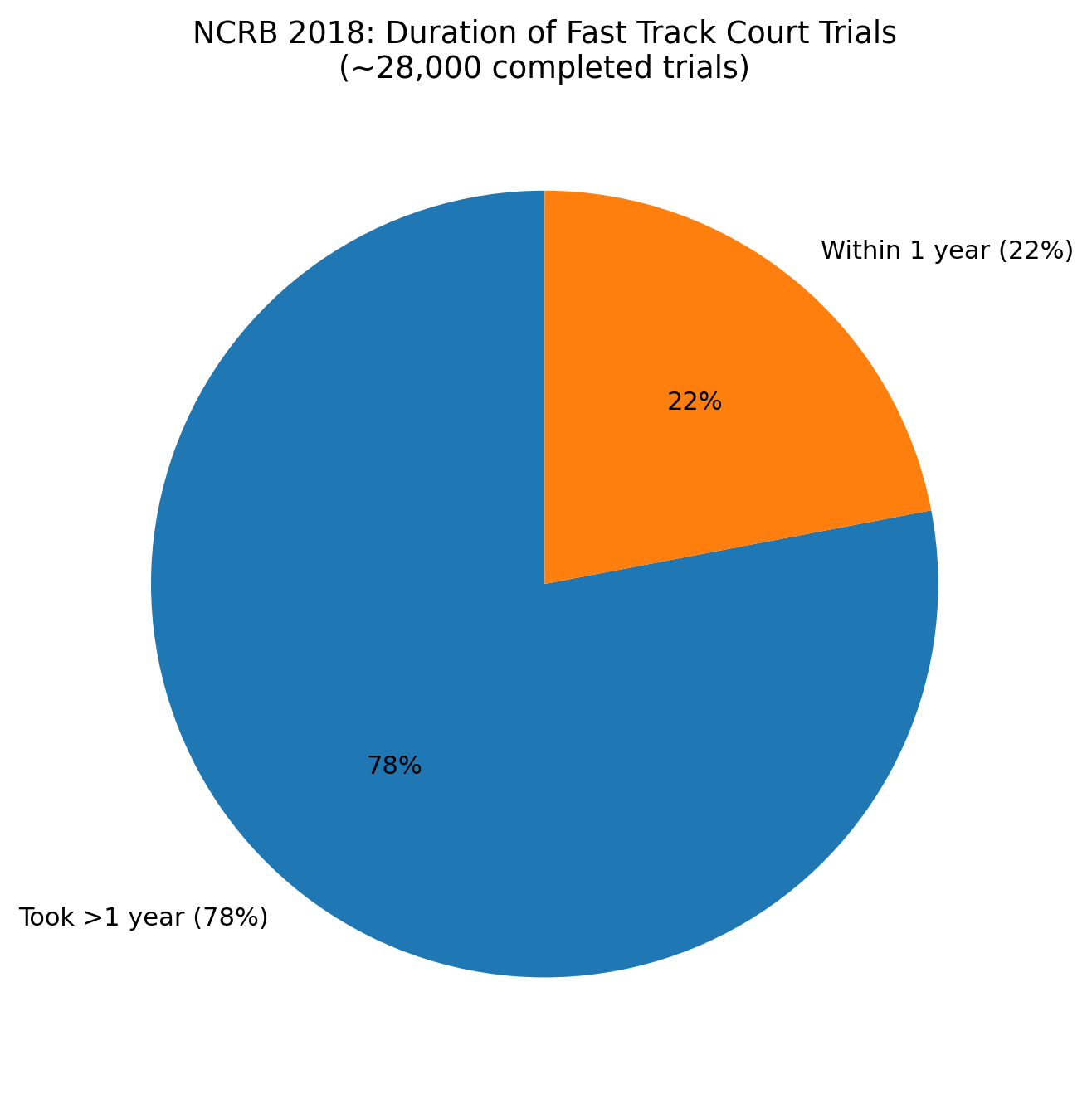
The same analysis found sharp disparities between States. While a large share of cases in Haryana and Chhattisgarh were completed within a year, Fast Track Courts in most other States concluded fewer than 10 per cent of trials within that period. This unevenness exposes the weakness of a uniform announcement operating through unequal State capacity. (The Leaflet)
Government figures from 2022 provide further context. At that time, 712 Fast Track Special Courts had 1,86,753 pending cases. They had disposed of 81,462 cases during the reporting period up to February 2022. Uttar Pradesh alone had 73,962 pending cases before its 218 courts. Delhi’s 16 courts had 4,517 pending cases and had disposed of only 249 during the period reported.
The number of functioning regular Fast Track Courts has also fluctuated instead of expanding steadily. It rose from 676 in 2018 to 907 in 2020, fell to 898 in 2021 and stood at 915 in January 2022. By January 2026, the number was 862. The country therefore had fewer operational regular Fast Track Courts in 2026 than it had four years earlier.
This decline is important. It shows that the model is dependent upon the priorities, finances and administrative capacity of individual States. Central funding for regular Fast Track Courts was discontinued after March 2015, leaving States to establish and maintain them according to their own resources.
Disposal figures do not tell the whole story
Governments frequently cite the number of cases disposed of as evidence of success. That figure needs careful interpretation. Disposal can result from conviction, acquittal, withdrawal, procedural closure or the collapse of a prosecution due to weak evidence. A higher disposal rate does not necessarily establish that justice was swift, fair or effective.
A study cited by The Indian Express, based on 667 POCSO judgments, found that victims turned hostile in 67.5 per cent of cases. Judges also warned that relatively easier cases may be concluded first while complex cases remain pending because investigations are incomplete. Disposal statistics can therefore improve without resolving the hardest cases or delivering meaningful justice to victims. (The Indian Express)
A credible evaluation must examine how long each case took, the age of the pending cases, judicial vacancies, conviction outcomes, quality of investigation, reasons for acquittal, forensic delays, witness protection and the experience of victims. Yet the Government has admitted that no recent independent third party evaluation of regular Fast Track Courts has been undertaken.
The Government’s approach has focused heavily on counting institutions. As of June 2025, according to the source document, 725 Fast Track Special Courts, including 392 exclusive POCSO courts, had disposed of 3,34,213 cases since inception. The scheme carried an outlay of ₹1,952.23 crore, including a Central share of ₹1,207.24 crore, while ₹1,034.55 crore had been released to States and Union Territories. These numbers establish scale, but they do not establish timely justice.
Paper leaks require prevention, accountability and restitution
The crisis in public examinations cannot be resolved primarily through criminal trials. By the time a paper leak case reaches court, the damage has already occurred. Students have lost an academic year. Families have spent money on coaching, travel and accommodation. Age limits may have closed. Mental health may have deteriorated. Public confidence may have collapsed.
The first responsibility of the Government is prevention. Examination systems require digitally secured question banks, randomised papers, strict access controls, transparent audit trails, independent oversight and immediate identification of breaches. Investigations require specialised police teams, cyber expertise, protected evidence chains and time bound chargesheets. Students require immediate reexaminations, financial compensation and institutional support when an examination is compromised.
Fast Track Courts enter the picture only after all these systems have failed.
Even then, speed will remain impossible unless the courts are supported by dedicated judges, trained prosecutors, specialised investigators, sufficient staff, modern courtrooms, functioning forensic laboratories and witness protection. Otherwise, paper leak cases will join the same queue of delayed investigations, incomplete chargesheets and repeated adjournments that has weakened the existing Fast Track Court system.
Accountability cannot be replaced by an announcement
PM Modi’s proposal may form one part of a broader reform package, but presented as the principal response to the examination crisis, it is a piecemeal measure. The empirical record shows that Fast Track Courts frequently function at the pace of the wider criminal justice system. Many have no enforceable disposal deadlines. Judges are overburdened. Investigations are delayed. Forensic reports arrive years late. Vacancies remain unfilled. Performance varies sharply across States. The Government does not even possess a recent independent evaluation of regular Fast Track Courts.
Students are therefore entitled to ask whether this announcement is designed to deliver justice or to manage public anger.
The examination crisis is fundamentally a crisis of governance and accountability. Unless Union Education Minister Dharmendra Pradhan accepts moral responsibility and resigns, the announcement of Fast Track Courts will remain tokenism. It will be seen as an attempt to divert attention from the collapse of the examination system, the suffering of students and the failure of those entrusted with protecting their future.